
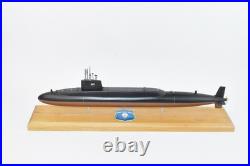
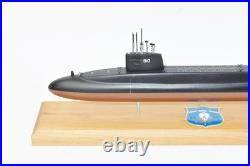
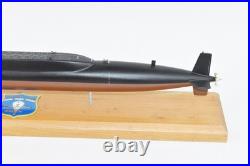
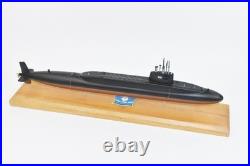
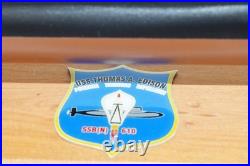

Edison SSBN-610 Submarine Model. Dive with the USS Thomas A. Edison SSBN-610 again in this handcrafted 20-inch submarine. Each piece is carved from wood and handpainted to provide a piece you’ll love. Length – 20 inches. US Veteran Owned Business. The product is not intended to be used by children 12 years and younger. Construction and commissioning Thomas A. Edison’s keel was laid down on 15 March 1960 by the Electric Boat Division of the General Dynamics Corporation of Groton, Connecticut. She was launched on 15 June 1961 sponsored by Mrs. Madeleine Edison Sloane, and commissioned on 10 March 1962 with Captain Charles M. Young commanding the Blue Crew and Captain Walter Dedrick commanding the Gold Crew. Service history On 9 April 1962, during shakedown training off the eastern coast of the United States, Thomas A. Edison collided with the destroyer USS Wadleigh (DD-689). Edison loaded Polaris missiles at Charleston, South Carolina, and embarked upon her first deterrent patrol on 7 November 1962. She concluded that patrol at the base at Holy Loch, Scotland, from which she operated for the next four years and conducted 17 deterrent patrols. In September 1966, her official home port was changed from New London, Connecticut, to Charleston, South Carolina, in preparation for her first major overhaul. She ended her 17th patrol at Charleston on 15 October 1966 and began her overhaul on 28 October 1966. She completed repairs on 9 May 1968; and, after post-overhaul sea trials and shakedown, she embarked upon her 18th deterrent patrol on 22 September 1968. After a shortened 19th patrol, she conducted a “Follow on Target” (FOT) test launch. For this test, four missiles were selected at random, their warheads were removed, and telemetry packages were fitted in place of the warheads. Edison then proceeded to a location just off the Canary Islands and fired these missiles into the Caribbean. Due to the accuracy and timeliness of these successful launches, the members of that Blue Crew were awarded a Meritorious Unit Citation. Through June 1973, Thomas A. Edison operated out of New London and Rota, Spain, from which ports she conducted another 19 deterrent patrols in the Mediterranean Sea. In June 1973, she was transferred to the United States Pacific Fleet, arriving in San Diego, on 11 July 1973. After a short period of operations with Submarine Group 5, she moved to Vallejo, California, on 6 August 1973 to begin another overhaul, this time at the Mare Island Naval Shipyard at Vallejo, California. On 30 November 1974, she completed repairs and, following shakedown in January and February 1975, she transited the Panama Canal again in March 1975 to fire test missiles near Cape Canaveral, Florida. She concluded that mission in July and retransited the Canal on 8 August 1975. Edison carried out operations along the United States West Coast until December 1975, at which time she headed for her new home port, Apra, Guam. On 6 October 1980, Thomas A. Edison completed her final deterrent patrol and was reclassified an attack submarine, given hull number SSN-610. [2] In 1981, in compliance with the SALT I treaty, [citation needed] Thomas A. Edison’s missile section was deactivated. In August 1982 Thomas A. Edison conducted the first Western Pacific deployment by an ex-SSBN. During deployment, her crew enjoyed visits to Japan, Korea, Thailand and the Philippines. On 29 November 1982, 40 miles (64 km) east of Subic Bay, Philippines, Thomas A. Edison collided with USS Leftwich (DD-984) while conducting ASW exercises. Edison was at periscope depth. Her sail and sail planes were damaged, but there was no flooding apart from a minor leak down the periscope well. After the collision the boat never submerged again. She went to Subic Bay for temporary repairs, then made a 35-day transit across the Pacific on the surface to Bremerton, Washington, where she had home ported as an SSN. The original planwhen? Edison was in the best material shape of the Ethan Allen-class boats, so she was chosen for this mission. The Navy had planned to decommission the USS Ethan Allen (SSBN-608) or USS Sam Houston (SSBN-609), but after the collision it was decidedby whom? To decommission Thomas A. In January 1983, Thomas A. Edison entered the Puget Sound Naval Shipyard for inactivation. Decommissioned on 1 December 1983, Thomas A. Edison was struck from the Naval Vessel Register on 30 April 1986. Steinway piano During the construction of Thomas A. Edision, the construction captainwho? Requested that a Steinway piano be placed aboard. The Steinway piano is the only example of a full-sized piano ever installed on a U. Submarine conducting nuclear deterrent patrols.