
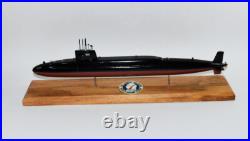
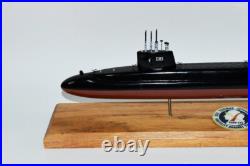
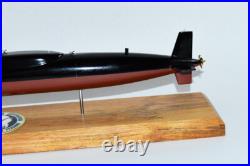
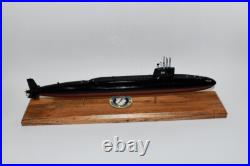

Thomas Jefferson (SSBN-618) Submarine. Dive with the Thomas Jefferson (SSBN-618) again in this handcrafted 20-inch submarine. Each piece is carved from wood and handpainted to provide a piece you’ll love. Length – 20 inches. US Veteran Owned Business. The product is not intended to be used by children 12 years and younger. She later was reclassified as an attack submarine and redesignated SSN-618. Construction and commissioning Thomas Jefferson’s keel was laid down on 3 February 1961, at Newport News, Virginia, by the Newport News Shipbuilding sponsored by Mrs. McNamara, wife of United States Secretary of Defense Robert McNamara; and commissioned on 4 January 1963, Commander Leon H. Rathbun commanding the Blue Crew and Commander Charles Priest, Jr. Commanding the Gold Crew. Thomas Jefferson was initially a fleet ballistic missile submarine and was later converted to an attack submarine. On 28 October 1963, the Blue Crew took the submarine on her first deterrent patrol which ended at Holy Loch, Scotland, in December 1963. Thomas Jefferson continued patrols from Holy Loch for the next four years and also acted as flagship for Submarine Squadron 14. On 17 June 1968, Thomas Jefferson was ready for sea, and refresher training was held for both crews. Her 16th deterrent patrol began on 29 October and terminated at Rota, Spain, on 5 December 1968. Thomas Jefferson made four deterrent patrols in each of the following years: 1969, 1970, 1971, and 1972. She also conducted special operations in 1970 and 1971. On 20 October 1972, the Gold Crew was awarded a Meritorious Unit Commendation for its special operations of the previous year. Thomas Jefferson completed two patrols in 1973 before returning to the United States to hold midshipman training from 18 June to 31 August. Her last patrol of the year terminated on 12 December 1973. Her 36th and final, patrol in the Atlantic lasted from 31 January to 22 March 1974. Thomas Jefferson was then reassigned to the Pacific Fleet with her new homeport at Vallejo, California. She stood out of New London on 7 June en route to the United States West Coast and arrived at Mare Island on 27 June. On 1 July 1974, Thomas Jefferson entered the Mare Island Naval Shipyard for overhaul, refueling, and conversion to the Polaris A-3 missile system. She remained in the shipyard until 17 November 1975 when she got underway for Bremerton, Washington. The submarine remained in Puget Sound for a month and then moved to San Diego, California. During the period January to March 1976, Thomas Jefferson’s Blue Crew conducted post-overhaul shakedown operations and then transited the Panama Canal to conduct a Polaris missile firing at Cape Canaveral, Florida. There was fire and flooding which caused a reactor scram during ORSE(Operational Reactor Safety Exam). If not for the training the crew had, this event may have resulted in tragedy. After successful ascent, the boat proceeded under its own power back to San Diego where an investigation resulted in better training for the ORSE Board Examiners. Thomas Jefferson continued these operations as a unit of Submarine Squadron 15 from 1977 to 1980, at the end of which she completed her 51st deterrent patrol. Concrete blocks were placed in the missile tubes, and the missile fire-control system was removed. The sail is preserved in Gosport park adjacent to the Norfolk Naval Shipyard in Portsmouth, Virginia.