
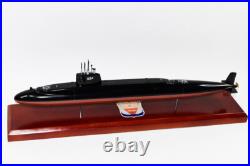
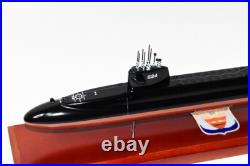

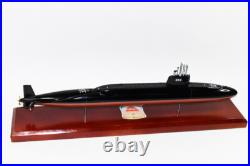
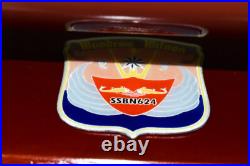

USS Woodrow Wilson SSBN-624 Submarine Model. Sail again with the crew of the USS Woodrow Wilson SSBN-624 in this handcrafted wooden Submarine Model. Each piece is carved from wood and handpainted to provide a piece you’ll love. Length – 20 inches. The product is not intended to be used by children 12 years and younger. She later was converted into an attack submarine and redesignated SSN-624. Construction and commissioning The contract to build Woodrow Wilson was awarded to Mare Island Naval Shipyard at Vallejo, California, on 9 February 1961 and her keel was laid down there on 13 September 1961. She was launched on 22 February 1963 sponsored by Miss Eleanor Axson Sayre (Wilson’s granddaughter), and commissioned on 27 December 1963, with Commander Cleo N. Mitchell in command of the Blue Crew and Commander Walter N. Dietzen in command of the Gold Crew. Woodrow Wilson departed Mare Island Naval Shipyard on 9 January 1964, bound for the United States East Coast. After stopping briefly at San Diego, she proceeded on to the Panama Canal, arriving on 19 January 1964 at its western end. Violent anti-American demonstrations and riots over a recent flag-displaying incident had resulted in an extremely tense atmosphere. As a result, she transited the canal in a record seven hours ten minutes while combat-ready United States Marines and United States Army soldiers guarded the locks. Making port at Charleston, South Carolina, on 5 February 1964, Woodrow Wilson conducted a shakedown cruise off the lower U. East Coast into March 1964 and underwent post-shakedown repairs and alterations into April 1964. She put to sea at the end of May 1964 upon the conclusion of these repairs and alterations and commenced her first deterrent patrol out of Charleston in June 1964. Woodrow Wilson subsequently operated in the Atlantic Ocean until the autumn of 1968, conducting patrols from forward bases at Rota, Spain and Holy Loch, Scotland. She then continued on to the western Pacific Ocean, was based at Guam, and conducted deterrent patrols from Apra Harbor through 1972. In 1972, Woodrow Wilson shifted back to the Atlantic and another overhaul and conversion to the Poseidon C3 missile at Newport News Shipbuilding. She was then home-ported at Charleston for operations with the United States Atlantic Fleet. On 4 June 1979, Woodrow Wilson ran aground in heavy fog at Race Rock while en route to New London, Connecticut. The submarine was able to free itself and proceed to port for inspection of the damage. After several overhauls in the Charleston Naval Shipyard and 40 more deterrent patrols, Woodrow Wilson entered the Charleston Naval Shipyard for its final refueling overhaul in 1988. CDR Charles Peterson was relieved of both crews by CDR Glen Dilgren in August of 1989. Hurricane Hugo struck on September 21, 1989 and resulted in a one month shipyard shutdown. During Alfa sea trials in June of 1990 and as a result of the Strategic Arms Reduction Treaty, Woodrow Wilson was directed to condense the crew, deactivate the missile systems and convert to an SSN. Woodrow Wilson was assigned missions in Fleet and NATO Exercises, Atlantic SSN Operations and a primary tasking in the development of new submarine and Naval Special Warfare tactics. In the spring of 1992, Woodrow Wilson conducted a successful MK 48 warshot SINKEX during her 30th underway since completion of overhaul two years before. CDR Glen Dilgren was relieved by CDR Marshall Page in April of 1992. Woodrow Wilson was deactivated in September 1993. She was decommissioned on 1 September 1994 and stricken from the Naval Vessel Register the same day. Recycling of Ex-Woodrow Wilson was completed on 27 October 1998. Commemoration Woodrow Wilson’s sail is preserved as part of the Deterrent Park monument at Naval Base Kitsap in Bangor, Washington.