
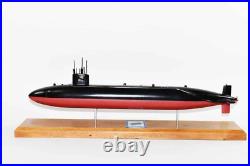
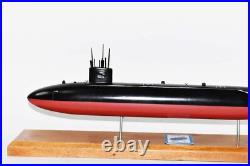
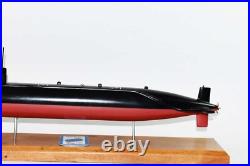
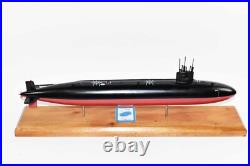

USS Jack SSN-605 Submarine Model. Sail again with the crew of the USS Jack SSN-605 in this handcrafted wooden Submarine Model. Each piece is carved from wood and handpainted to provide a piece you’ll love. Length – 20 inches. She saw extensive service during the Cold War. Construction and commissioning The contract to build Jack was awarded to Portsmouth Naval Shipyard in Kittery, Maine, on 13 March 1959 and her keel was laid down there on 16 September 1960. She was launched on 24 April 1963, sponsored by Mrs. Grace Groves, the wife of Lieutenant General Leslie R. Groves, who had been the head of the Manhattan Project. She was commissioned on 31 March 1967, with Commander Louis T. The principal speaker at her commissioning ceremony was Rear Admiral James F. Calvert, USN, who served with distinction in the Pacific during World War II on Jack’s predecessor, the submarine USS Jack (SS-259). While Jack was under construction, her pre-commissioning crew won the annual Portsmouth Naval Shipyard “Admiral’s Trophy” in 1966 for overall excellence in athletic competition during 1965. Jack was the first submarine to win the trophy. Unique silencing features Jack was a variation on the standard Permit-class design. She was 20 feet (6.1 m) longer than her sisters and used an experimental direct-drive plant with two contra-rotating propellers on concentric shafts. This allowed the propellers to be smaller and thus make less noise (termed blade rate) when interacting with the hull’s uneven wake, with no loss of thrust. It was judged that the specialized gearing and extra shaft watertight packing required by this solution was less effective than the alternative adopted on the other Permits: a much larger, scythe-shaped or skew-shaped propeller that interacted with the wake more slowly (another possible solution was the pump-jet, which would be adopted on the later Seawolf-class). Operational history Early career Upon commissioning, Jack was assigned to Commander Submarine Squadron 10 in New London, Connecticut. Jack spent her entire career assigned to Squadron 10. After a shakedown cruise in the Caribbean, Jack took her place in the operational fleet. 1968 On 22 June 1968, Commander David G. Smith relieved Commander Urbanczyk of command of Jack at State Pier in New London, Connecticut. In September and October 1968, the North Atlantic Treaty Organization (NATO) held Exercise Silver Tower, its largest combined naval exercise since 1964. 1969 Completing the availability in March 1969, Jack participated in a Caribbean training exercise, Exercise Springboard. As a result of Jack’s performance during the exercise, her weapons department was awarded the Battle Efficiency “E” for fire control excellence. Later in 1969, Jack was assigned a secret special operation. The performance of the crew during that operation resulted in the following letter from the Chief of Naval Operations:[citation needed]. The Secretary of the Navy takes pleasure in presenting the Meritorious Unit Commendation to USS JACK (SSN-605) for service as set forth in the following CITATION. For meritorious service during a period in 1969 in conducting an important and arduous independent submarine operation. In successfully completing the operation, USS JACK achieved significant results of great importance to the national defense of the United States. These results were attained primarily through the professional skills, resoursefulness, and teamwork of USS JACK’s officers and men. Their dedication to the fulfillment of a vital and difficult assignment reflects credit upon themselves and the United States Naval Service. All personnel attached to and serving on board USS JACK (SSN-605) during the period of this citation are hereby authorized to wear the Meritorious Unit Commendation Ribbon. For the Secretary, /s/ T. Moorer, Admiral, United States Navy, Chief of Naval Operations. Jack later received a second Meritorious Unit Commendation. 1970 During the summer of 1970, while Jack was engaged in midshipmen training at the United States Naval Academy in Annapolis, Maryland, she was awarded the Battle Efficiency “E” by Commander, Submarine Force, Atlantic. 1971 On 11 February 1971, Jack arrived at the Portsmouth Naval Shipyard to begin an extensive, 12-month overhaul. 1972 In early 1972, toward the end of her overhaul, the United States Atlantic Fleet’s Operational Reactor Safeguards Examining Board inspected Jack. The board conducted interviews of crew members, observed operational drills, examined records, and tested the knowledge of crew members. Upon completion of the inspection, Jack received the highest grade awarded by the fleet commander’s examining board. On 22 July 1972, Commander Thomas F. Wiener relieved Commander David G. Smith as commanding officer of Jack. Shortly thereafter, on 31 July 1972 Jack deployed to the Mediterranean[citation needed] as part of a build-up of the US navy in that operational area. Jack was the first nuclear submarine to make port at the newly opened submarine base in La Maddalena, Italy. During sea trials in the North Atlantic, state six seas allowed a rush of seawater to travel down the induction mast, overflowing the induction sump and into the battery breaker room. This caused an explosion and fire. Several people were injured; according to HM1 Rodger Burdock, one sonar tech had his ear drums totally sucked out by a bad valve line up for venting. 1981 On 27 April 1981, Jack was moored alongside the amphibious transport dock USS Trenton (LPD-14) in heavy swells at Alexandria, Egypt, when she collided with Trenton. In April 1983, while in dry dock, she suffered a casualty. While conducting a hydrostatic test of the oxygen banks, the shipyard was using Freon (R-12) as the fluid to conduct the test (the Freon would leave no residue and potential contamination in the O2 banks upon evaporation after the test). One of the shipyard workers was unable to get out of the engineering space in time, and succumbed to the oxygen deprivation effects of the Freon and was not able to be revived. Decommissioning and disposal Jack was decommissioned and stricken from the Naval Vessel Register on 11 July 1990. Recycling was completed on 30 June 1992.